

Foundations of Artificial Intelligence, Machine Learning, and Supporting Mathematics

Executive Summary
Artificial Intelligence (AI) is a broad and rapidly evolving field dedicated to developing systems capable of performing tasks traditionally requiring human intelligence. Within this field, Machine Learning (ML) and Deep Learning (DL) serve as critical subfields, providing the mechanisms for systems to learn from data, identify patterns, and adapt without explicit programming.
The relationship between these concepts is hierarchical: AI encompasses ML, which in turn encompasses neural networks and Deep Learning. These technologies are currently being deployed to solve complex problems in diverse sectors, including healthcare, finance, cybersecurity, and autonomous transportation. Supporting these advanced computational techniques is a rigorous mathematical framework spanning linear algebra, calculus, probability theory, and set theory. Mastery of these mathematical foundations—ranging from matrix operations to conditional probability—is essential for understanding the underlying algorithms that drive modern intelligent systems.
Defining the AI Hierarchy
While the terms Artificial Intelligence, Machine Learning, and Deep Learning are often used interchangeably, they represent distinct layers of complexity and specialization.
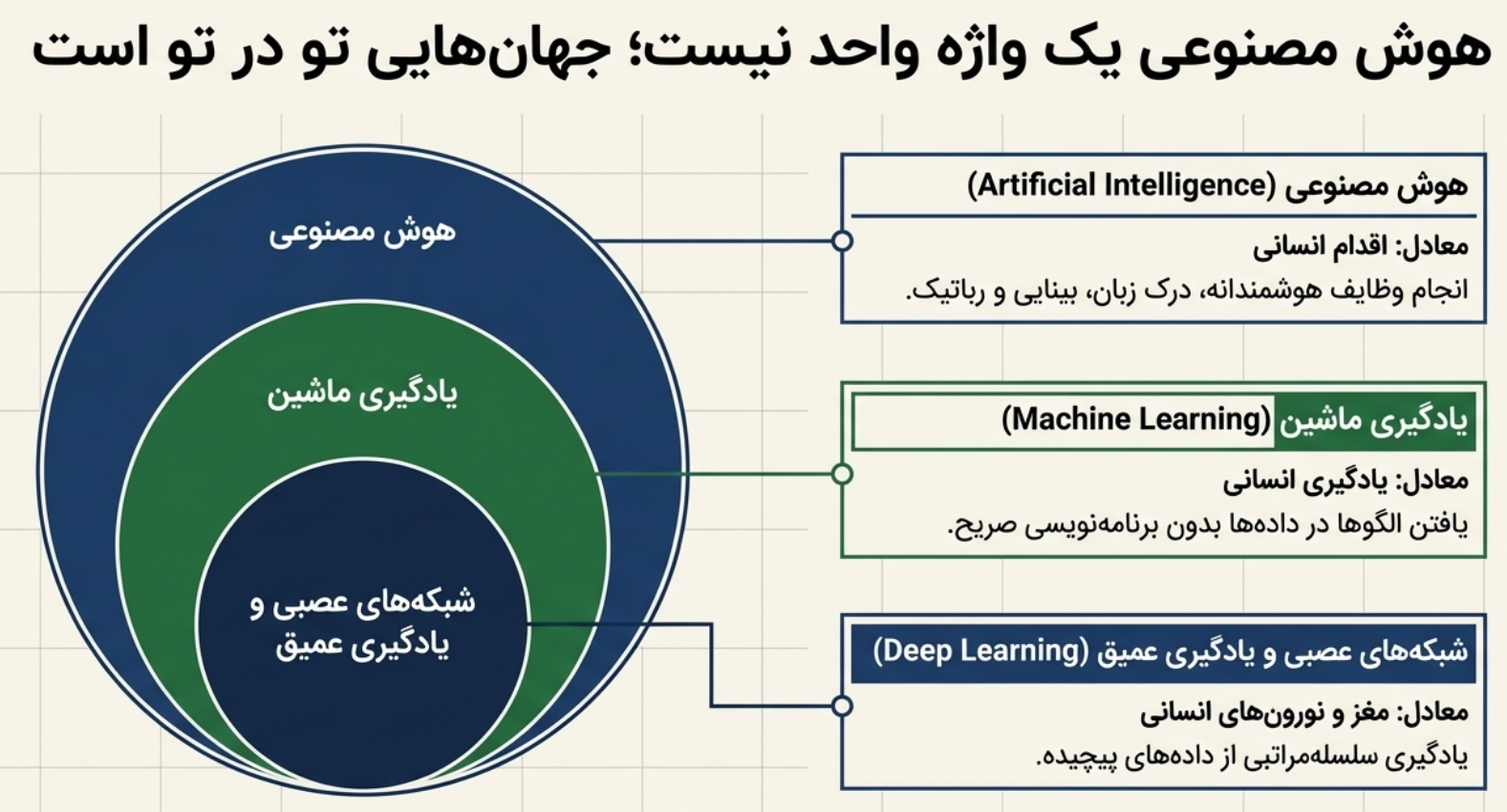
Artificial Intelligence (AI)
AI is the overarching field focused on creating systems that exhibit cognitive abilities such as reasoning, perception, and problem-solving. Its primary goal is to augment human capabilities and enhance productivity. Key areas include:
Natural Language Processing (NLP): Understanding and generating human language.
Computer Vision: Interpreting visual data from images and videos.
Robotics: Developing autonomous or human-guided physical agents.
Expert Systems: Mimicking the decision-making processes of human experts.
Machine Learning (ML)
ML is a subfield of AI that uses statistical techniques to enable systems to learn from data. It is categorized into three primary learning styles:
Supervised Learning: Learning from labeled data (e.g., spam detection, image classification).
Unsupervised Learning: Identifying patterns in unlabeled data (e.g., customer segmentation, anomaly detection).
Reinforcement Learning: Learning through trial and error via environmental feedback (e.g., game playing, autonomous driving).
Deep Learning (DL)
DL is a specialized subfield of ML that utilizes multi-layered neural networks to extract features from complex, unstructured data.
Hierarchical Feature Learning: Lower layers capture simple features (edges), while higher layers identify complex structures (objects).
End-to-End Learning: Models map raw input directly to output, bypassing manual feature engineering.
Scalability: These models perform exceptionally well with large datasets and high-dimensional data.